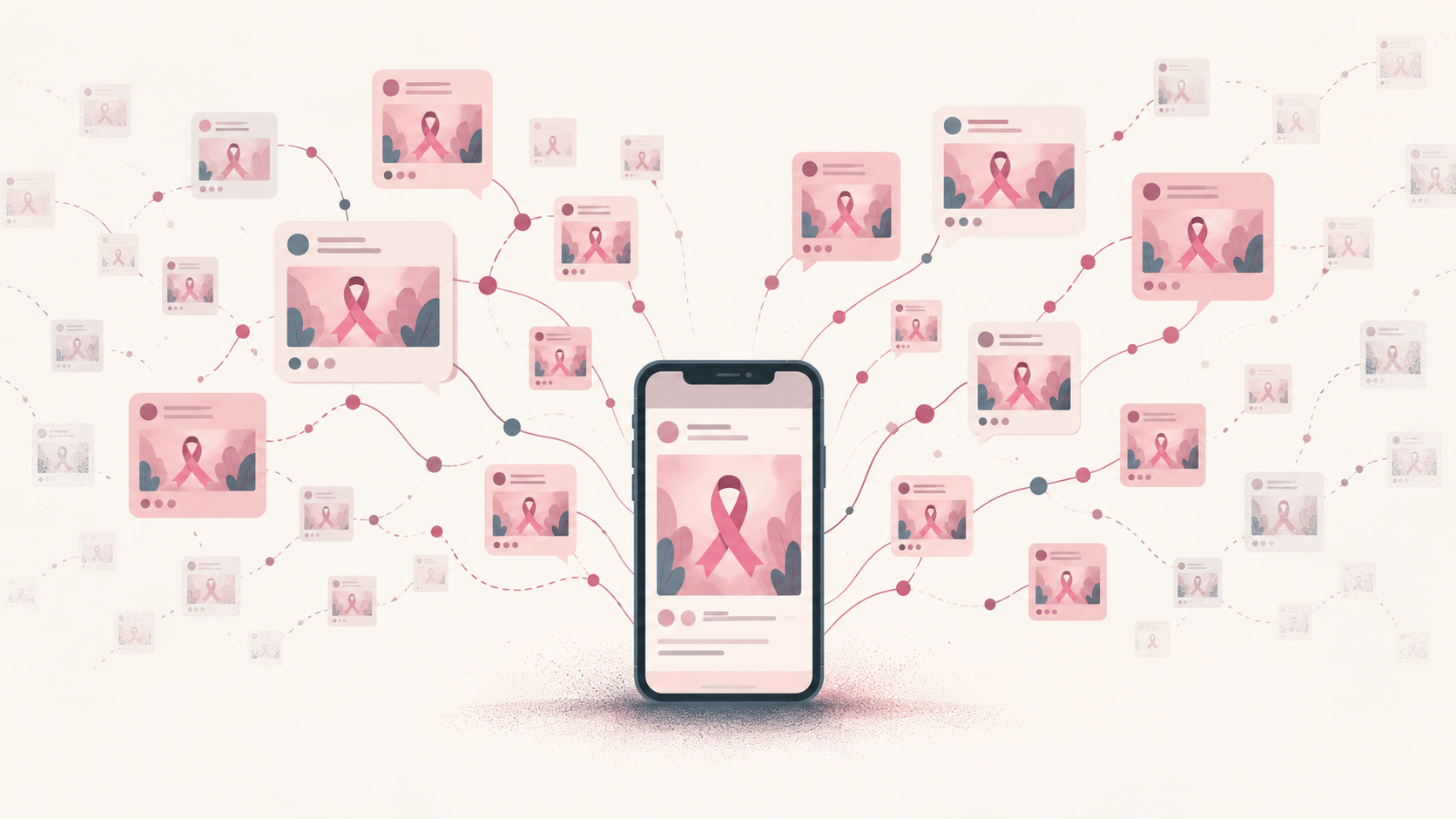
A color suddenly appears in a friend’s Facebook status. Someone else posts where she likes to leave her purse. The messages seem suggestive, but their actual meaning is hidden. Women receive private instructions explaining that the posts are supposed to promote breast cancer awareness, while men are intentionally left guessing.
The Breast Cancer Meme described by Mahoney and Tang in Chapter 4 of Strategic Social Media spread because it worked like a social game. Posting required almost no effort, and the unexplained answers generated curiosity. As more people participated, the meme gained visibility through their personal networks.
That sounds like a social media success. I am not convinced it was.
Participation Without an Owner
The campaign demonstrated the power of user-generated content. Participants did not simply receive a message from an organization. They reproduced it and invited others into the experience. The audience became the distribution system.
Giving users that much control helped the meme travel, but it also created its central weakness: there was no visible owner responsible for explaining the message.
Most posts did not identify a breast cancer organization or connect readers with reliable information. A person encountering one of the coded statuses could not tell who started the campaign or what outcome it was intended to produce. Even participants had little direction beyond posting their answers and privately sharing the instructions.
The case notes that the Susan G. Komen Foundation experienced increased interest and donations while the memes circulated. That does not establish that the memes caused either result. The activity also coincided with the beginning of Breast Cancer Awareness Month, when attention would already be expected to increase.
Without a campaign owner, there was no practical way to connect exposure with a result. The meme could count participation only in the loosest sense: people posted because other people asked them to post.
The Message Changed as it Traveled
Decentralized communication always gives audiences some control over meaning. In this case, the coded and suggestive language frequently became more memorable than the cause itself. Curiosity drove diffusion, but secrecy limited understanding.
Excluding men created another problem. The joke depended on keeping them outside the conversation even though, as the Centers for Disease Control and Prevention explains, men can also develop breast cancer. The campaign therefore reduced its potential audience while reinforcing an incomplete impression of who may be affected.
This does not mean every awareness post must contain a medical lecture. It does mean that participation should eventually lead people to accurate information.
Sharing Control Without Losing the Campaign
I do not think the answer is to eliminate the social element that made the meme appealing. A formal post from an organization probably would not have traveled through personal networks in the same way. The better approach would preserve audience participation while making the source and purpose visible.
For example, an organization could invite people to post a personal message about someone affected by breast cancer. Each post could link to one campaign page containing trustworthy information and a meaningful next step. The organization could then measure visits to that page and completed actions rather than treating the number of mysterious status updates as proof of impact.
Participants would still shape the public message. The organization would retain responsibility for the information behind it.
What the Meme Actually Teaches Marketers
The Breast Cancer Meme did not fail because people were unwilling to help. It failed to make good use of their willingness.
Social media marketers often celebrate reach because it is easy to see. A message can spread widely while leaving its audience unsure of what it accomplished. User-generated content becomes more valuable when people understand whose message they are carrying and where their participation is supposed to lead.
The campaign proved that users could move a message. What it never established was whether the message moved anyone.
SOURCE NOTE
This post draws on the “Breast Cancer Meme” case study in Chapter 4 of Strategic Social Media by L. Meghan Mahoney and Tang Tang. Information about breast cancer in men comes from the Centers for Disease Control and Prevention. The featured image was created by Andy Nelson using OpenAI image generation.
